
Applying from abroad
The applicant must apply for the temporary digital nomad visa (VITEM XIV) at the competent Brazilian consulate, submitting the required documents and following the procedure set by the consulate serving their region.
Brazil allows foreign professionals to live in the country and work remotely for employers abroad. Learn the requirements and procedures for applying for the visa or residence permit.
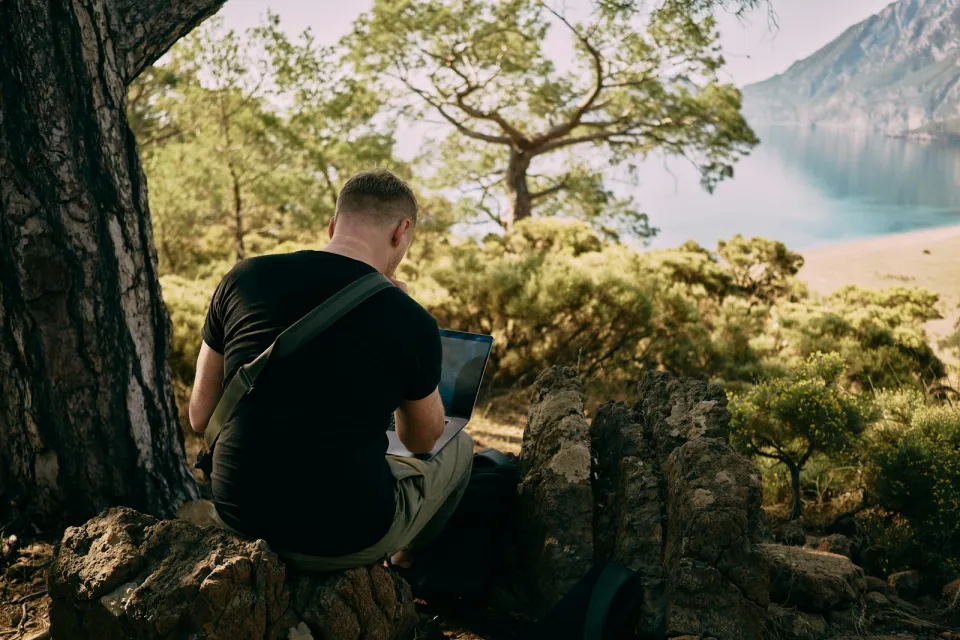
The digital nomad visa is an immigration category for foreigners who intend to stay in Brazil while carrying out their professional activities remotely, using information and communication technologies to work for a foreign employer.
The category is governed by Normative Resolution No. 45/2021 of the National Immigration Council (CNIg), which provides both for a temporary visa and for the option of applying for a residence permit directly in Brazil.
The visa is available to foreigners who can show that they work remotely for a foreign employer and meet the financial requirements set by the regulations. To show this, they must submit:
Means of support from a foreign source of payment: monthly income of at least US$1,500.00 or bank funds of at least US$18,000.00.
An employment contract, services agreement, or other documents proving the professional relationship with a foreign employer.
A statement that the applicant is able to carry out their professional activities remotely.
The amounts are alternatives: there is no need to prove both the monthly income and the bank balance.
Important note
The category is not intended for foreigners who work for an employer in Brazil, whether or not as employees, nor for situations covered by another specific work-based residence permit.
The documents vary according to the chosen path and the authority reviewing the application.
To apply for the visa at a Brazilian consulate:
A valid travel document, such as a passport.
Valid health insurance covering Brazil.
Proof of payment of the consular fees.
Proof of the means of transportation for entering Brazil.
A completed visa application form.
A criminal record certificate from the country of origin or an equivalent document accepted by the consular authority.
Documents proving digital nomad status.
To apply for a residence permit while already in Brazil:
Residence permit application form.
A valid travel document or an accepted identity and nationality document.
Proof of payment of the processing fee.
Documents proving digital nomad status.
A document proving parentage, when necessary, duly legalized and translated.
Criminal record certificates from the places where the applicant has lived in the last five years.
A statement of no criminal record in any country in the five years before the application.
Please note
The responsible authority may request additional documents depending on the circumstances of the application.
The procedure depends on whether the applicant is abroad or already in Brazil. The regulations provide two paths:
The applicant must apply for the temporary digital nomad visa (VITEM XIV) at the competent Brazilian consulate, submitting the required documents and following the procedure set by the consulate serving their region.
A foreigner already in Brazil can apply for a residence permit with the Ministry of Justice and Public Security, by submitting the documents required by the regulations.
The choice of procedure depends on the applicant's immigration status and the specific conditions of their stay in the country.
The initial term of the digital nomad residence permit is up to one year. The same term applies to the initial residence granted to foreigners who enter Brazil with the temporary visa in this category.
The residence can be renewed for the same period, with documents proving digital nomad status, a copy of the National Migration Registration Card (Carteira de Registro Nacional Migratório, CRNM), and criminal record certificates for the period of residence.
Please note
Renewal is not automatic and depends on meeting the applicable requirements.
Yes. Normative Resolution No. 45/2021 also allows foreigners to carry out remote professional activities as visitors.
In this case, the rules on length of stay and on any visitor visa requirement, which vary by nationality, must be followed.
This option should not be confused with the digital nomad residence permit, which is intended for those who plan to stay in Brazil under this immigration category.
Legal guidance makes it possible to assess whether the professional meets the legal requirements, identify the necessary documents, and determine which application procedure is appropriate.
It also helps with preparing the application and following up on requests from the immigration authorities, reducing the risk of inconsistent documents and difficulties during the review.
Choosing the immigration category and preparing the documents require attention to the particular features of each situation.
Legal guidance can help assess the requirements, the documents, and the right procedure for your situation.
Not necessarily. The regulations allow proof of monthly income of at least US$1,500.00 or available bank funds of at least US$18,000.00.
No. The category is intended for remote professional work for a foreign employer. Working for a Brazilian employer requires considering another type of authorization.
Yes. The regulations allow a foreigner who is already in Brazil to apply for a residence permit directly with the Ministry of Justice and Public Security.
Yes. The residence permit can be renewed for the same period, provided the requirements are met and the documents required by the regulations are submitted.
Explore the related topics. Select a card to read the details.Use the arrows to browse each topic.


Visas and residence for foreigners in Brazil.


Review of resident or non-resident status for tax purposes in Brazil.

Guidance on contracts, documents, and legal issues involved in acquiring property in Brazil.
Guidance on the CPF for people living outside Brazil.

Guidance on visa types, residence permits, and immigration procedures in Brazil.

Review of corporate structures to organize foreigners' assets and investments in Brazil.

Review of contracts and legal issues in business and relationships with an international dimension.
Legal information on documents, assets, residence, and other topics involving more than one country. This content is informational and does not replace an individual review of your case.

Learn why a CPF is not a visa when it comes to inheritance, family, or assets in Brazil, and what each document does for those living abroad.
Read article
Learn how inheritance works when there are assets abroad, the difference between applicable law and jurisdiction, and the precautions in probate.
Read article